You Have the License. Now You Need the Infrastructure.
By Venly Research | February 25, 2026
How broker-dealers can operationalize stablecoin holdings after the SEC's 2% haircut change — without adding a custodian to the stack.
On February 19, the SEC's Division of Trading and Markets quietly updated its crypto asset FAQ. The change is significant: broker-dealers can now apply a 2% capital haircut to qualifying payment stablecoins under Rule 15c3-1, down from the 100% that firms had been self-imposing.
The math is simple. A $100M USDC position that counted as $0 toward net capital last month now counts as $98M. Same asset, same reserves, same risk profile. Stablecoins just became as capital-efficient as government money market funds.
Our CEO Tim Dierckxsens published a full analysis on MoneyFlowIntelligence covering the regulatory shift, the qualifying criteria, and who moves first. This piece is about what comes next: the operational question every mid-tier broker-dealer is now asking. How do we actually do this?
The Self-Custody Shift Nobody's Talking About
Most coverage of the 2% haircut focuses on the capital treatment. The bigger structural change happened two months earlier.
On December 17, 2025, the SEC issued staff guidance clarifying how broker-dealers can establish "physical possession" of crypto assets under Rule 15c3-3. The five conditions are straightforward: exclusive access to private keys, robust cybersecurity controls, accurate record-keeping, policies preventing unauthorized access, and demonstrable compliance upon examination.
In plain English: broker-dealers can now self-custody digital assets.
This changes the infrastructure question entirely. The default assumption that every broker-dealer needs a third-party qualified custodian for stablecoins is no longer accurate. The SEC's guidance creates a second path — hold the keys yourself, with the right technology and controls in place.
The firms that understand this will build differently.
The Three-Vendor Problem
A broker-dealer that wants to hold and settle stablecoins today faces a fragmented infrastructure stack.
Vendor 1, Custody and Wallet Infrastructure. Private key management, wallet architecture, multi-chain support, and disaster recovery for cryptographic assets. This is the foundation. Without it, you cannot hold stablecoins on your balance sheet.
Vendor 2, Settlement Orchestration. Routing logic for stablecoin movements between counterparties, clearing systems, and internal accounts. This includes transaction monitoring, on-chain analytics, and reconciliation against your books and records.
Vendor 3, Fiat Rails. Converting between stablecoins and fiat currency across banking corridors. On-ramp, off-ramp, and multi-currency support. This is where most of the operational complexity lives, and where most wallet providers stop.
The incumbent providers like BitGo, Fireblocks, and Anchorage Digital are strong on custody. But none of them solve the full problem. Custody is necessary but not sufficient. A broker-dealer that puts stablecoins on its balance sheet still needs to move them — into fiat, out of fiat, across corridors, on settlement timelines that match the business. That's the gap.
!Three-vendor infrastructure comparison
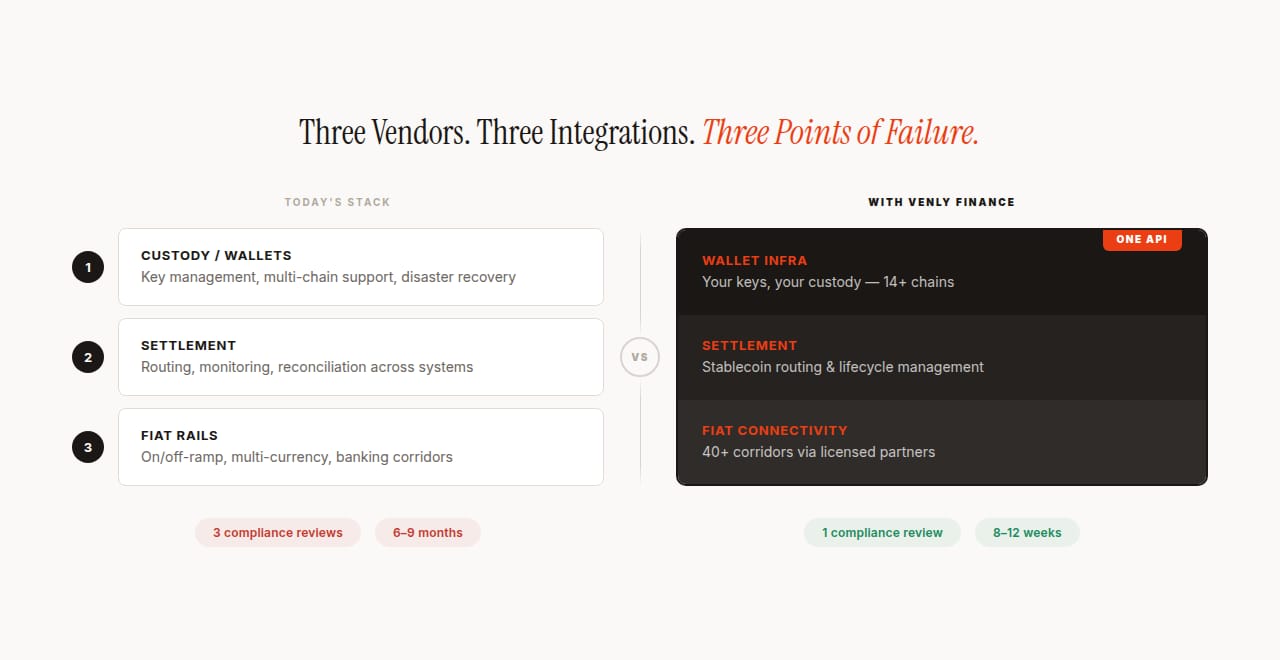
Three vendors. Three integrations. Three compliance reviews. Three points of failure.
A Different Architecture
Venly Finance approaches this differently. We do not compete with custodians for custody mandates. We build the infrastructure that lets regulated institutions manage their own digital assets and connect those assets to the financial system.
Wallet-as-a-Service. Wallet infrastructure built for the chains that matter for tokenized securities, including Ethereum, Solana, and 14+ networks. The broker-dealer holds its own keys, maintains exclusive control, and satisfies the SEC's December 2025 possession requirements. Certified to SOC 2 Type 2 and ISO 27001 standards.
Settlement Orchestration. Routing logic for stablecoin flows between counterparties and systems. Transaction lifecycle management from initiation through final settlement. This is the layer that turns "we hold stablecoins" into "we settle with stablecoins."
Fiat Connectivity. Stablecoin-to-fiat and fiat-to-stablecoin conversion across 40+ corridors through regulated partners including MoonPay and Iron. This is the piece no wallet provider or custodian offers: the bridge between on-chain assets and the banking system.
One API. One integration. One compliance review.
What This Looks Like in Practice
Consider a mid-tier broker-dealer with $200M in net capital, an existing equities business, and digital asset ambitions. The firm decides to operationalize the 2% haircut.
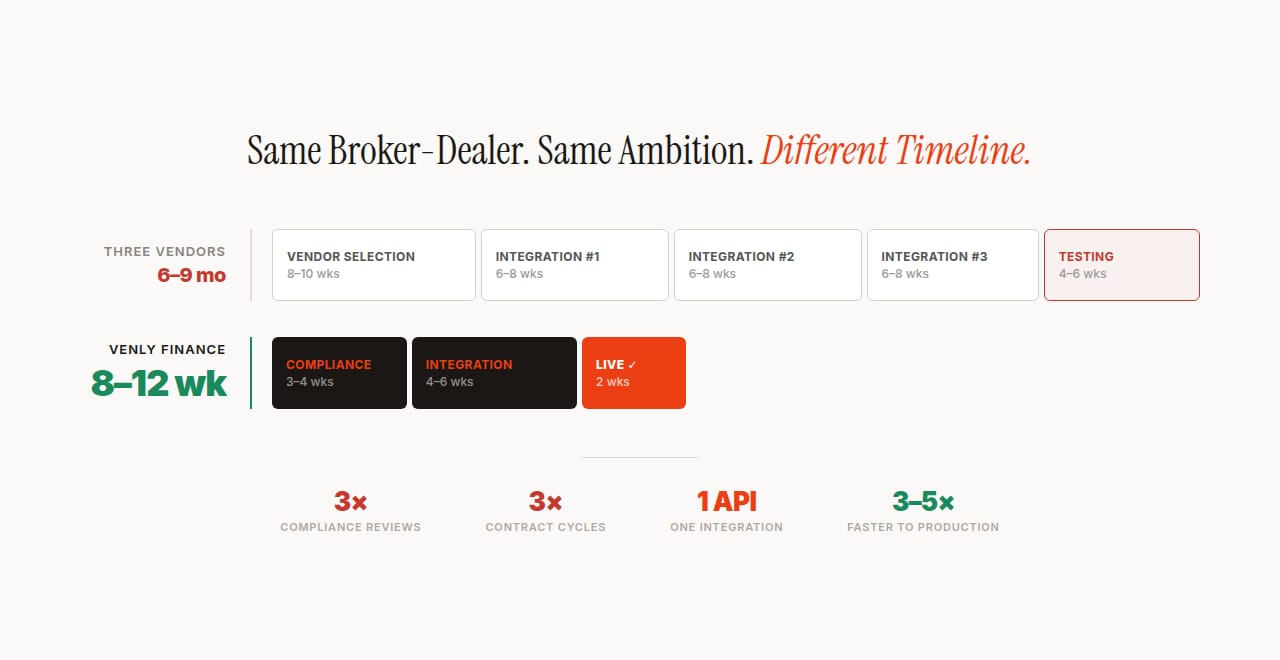
Without an orchestration layer, the firm contracts with a qualified custodian for key management, separately integrates a settlement provider for trade-level stablecoin movement, and separately contracts with a fiat on/off-ramp for USD conversion. Each vendor has its own compliance requirements, API surface, and SLA. The firm's operations team manages reconciliation across three systems. Time to live: 6–9 months.
With Venly Finance, the firm integrates a single API. Wallet infrastructure runs under the firm's control, with their keys and their possession under 15c3-3. Settlement orchestration handles stablecoin routing between counterparties and internal accounts. Fiat conversion flows through regulated partners, abstracted into the same interface. One compliance review. Time to live: 8–12 weeks.
The difference is not just speed. It is ongoing operational complexity. Three vendors means three upgrade cycles, three incident response chains, and three contract renewals. A single orchestration layer means one relationship and one point of accountability.
!Venly onboarding timeline comparison
What We Are and What We're Not
Transparency matters, especially when you're asking regulated institutions to build on your infrastructure.
Venly Finance is a European regulated virtual asset service provider and a wallet-as-a-service technology provider. We are SOC 2 Type 2 and ISO 27001 certified, operational across 14+ blockchains and 40+ fiat corridors through regulated banking and payment partners, and structured to enable broker-dealer self-custody under the SEC's December 2025 guidance. We are adding global licenses and partner with other regulated entities to extend coverage.
We are not a qualified custodian under US law. We do not hold your keys or your assets. We are not SEC or FINRA registered; we are a European technology company serving regulated US institutions under a technology services agreement. And we are not a replacement for legal and compliance counsel. The 2% haircut is staff-level guidance, not a rule, and your FINRA examiner should be part of this conversation.
If your compliance framework requires a US-qualified third-party custodian, use one. BitGo, Fireblocks, and Anchorage are credible options. But you will still need the settlement and fiat layers. That is where we fit.
The Window
The SEC's 2% haircut applies now. The self-custody guidance is live. The GENIUS Act will expand the qualifying stablecoin universe once enacted.
The broker-dealers that build stablecoin infrastructure in Q2 and Q3 of 2026 will have the operational playbook and the client relationships before the bulge bracket arrives. The first-mover window is 6–12 months before large-firm compliance teams complete their reviews.
Even if the FAQ is eventually formalized into permanent rulemaking — which Commissioner Peirce has signaled — the infrastructure investment holds regardless. Tokenized securities settlement, 24/7 liquidity operations, and cross-border stablecoin flows all require the same wallet and orchestration stack whether the haircut is 2% or 0%.
The question is not whether to operationalize stablecoins. The question is how quickly you can get live — and how many vendors it takes.
Next Step
We are offering technical briefings for broker-dealer operations and compliance teams evaluating stablecoin infrastructure. No pitch deck — a working session on architecture, compliance integration, and timeline to production.